Oct 11, 2024
Meteora
Notes on Meteora.
Concepts
AMM => Automated Market Maker. Market creation on blockchains. Win fees from LPing. Provides price quiotes to buy or sell LP => Liquidity Pool CLMM => Concentrated Liquidity Market Maker. Allows LPers to concentrate liquidity on certain price range. Helps win fees by specifying price range in which liquidity would be provided. Reduce price impact of trades in LPs TVL => Total Value Locked. US dollar value of the assets within a pool, protocol, etc at any given point in time Volume => Amount of trading over a period of time. Often it is measured as USD. Volatility => Measire of how much the price of a token has moved over a period of time. Slippage => Difference in price from the time between submitting the tx and when the tx is actually executed Price impact => The effect teh swap will have on the price, depending on the depth of the market (liquidity). The shallower (lower liquidity) the higher the price impact Market Cap => Total Value of all tokens in circulation. The higher the MC, the lower the price impact as there is more liquidity Bin => A container that holds liquidity at a single fixed price point Bin step => Difference in price between 2 consecutive bins. 1 Bin step pool == 1 Basis Point == 0.0001
Standard AMM vs CLMM
Standard AMMs are inneficient bc swaps tend to take place near the current price, only using a really smal amount of capital from the whole pool.
On the other hand, CLMM, allows LPers to set the range in which they wish to provide liquidity. Being more capital efficiency.
CLMM might miss some fees when the price goes higher or lower than the specified range. Impermanent loss occurs when tokens have been swapped by the pair and we are out of range, when withdrawing out of range, losses become permanent
Demand of tokens might go up or down pretty quick and the value might drop to 0 so, when LPing memecoins staying too long might get risky. Estasblished tokens can be safer but have lower rate of return. Risk Management is key when LPing
Meteora Dynamic Vaults - Basically lending
Vaults rebalance every minute across lending platforms to find the best possible yield while prioritizing user funds accesibility.
DLMM
Dynamic Liquidity Market Maker allows users to distribnute and shape their liquidity inside zero-slippage bins to maximize fees.
Liquidity is placed in bins. What are bins?
Bins
Container that holds liquidity. Can contain inifinite amount of one, two tokens or none. Once created, these bins exist forever and define a certain price point. As such, when liquidity is placed into a bin by a user, the bin is not owned by the user. It is shared by all the LPers that provide liquidity on that price range. These bins will always exist on chain, no matter if they have tokens or not.
Only the bin at the current price, contains both tokens at the same time, the rest of the bins, will hold one token or the other. Tokens on the current bin will be swapped by one token or the other and we will earn fees from that. Trades happening in the bin do not suffer from slippage. Price of token will not move up or down until all the tokens of one kind are fully exchanged.
Once that happens, the price will move to the next bin. To calculate next bin price multiply current price by the bin step (1.0001). To calculate the lower bin, divide.
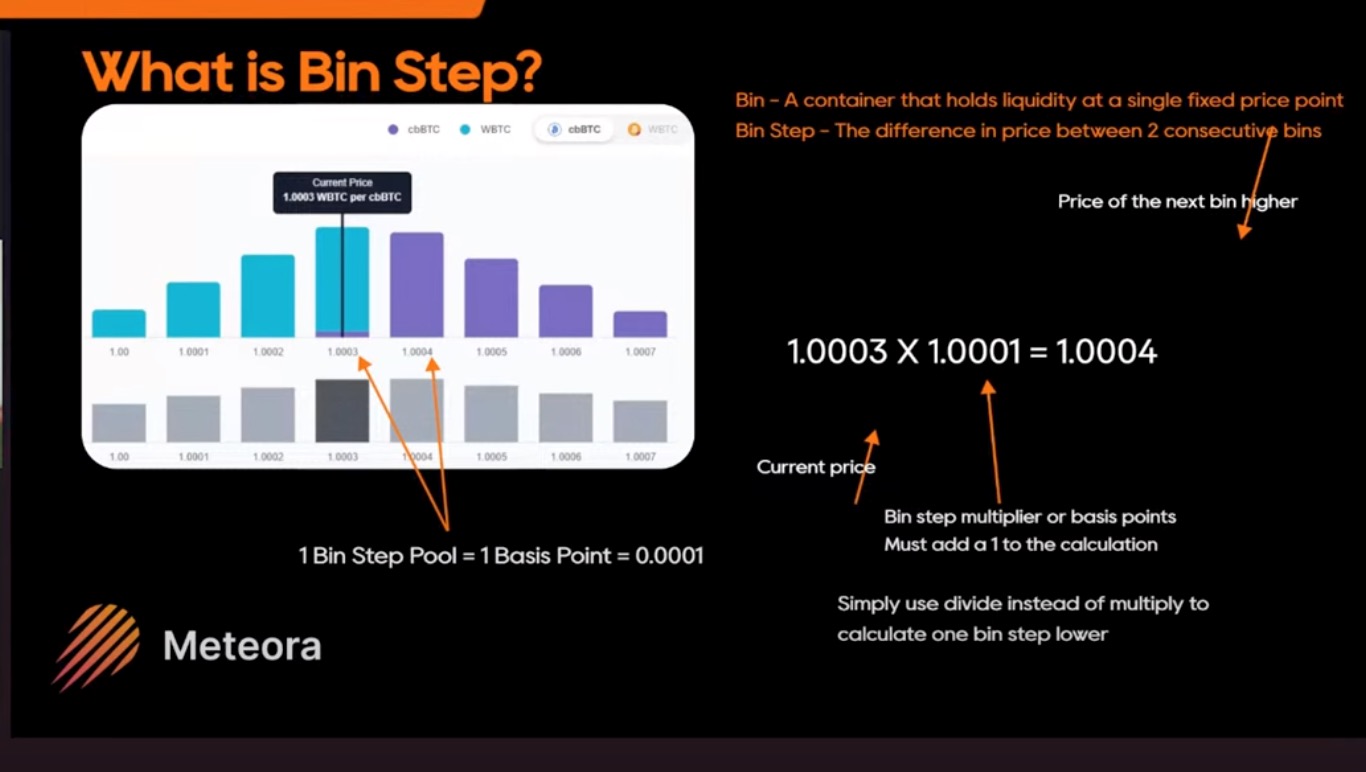
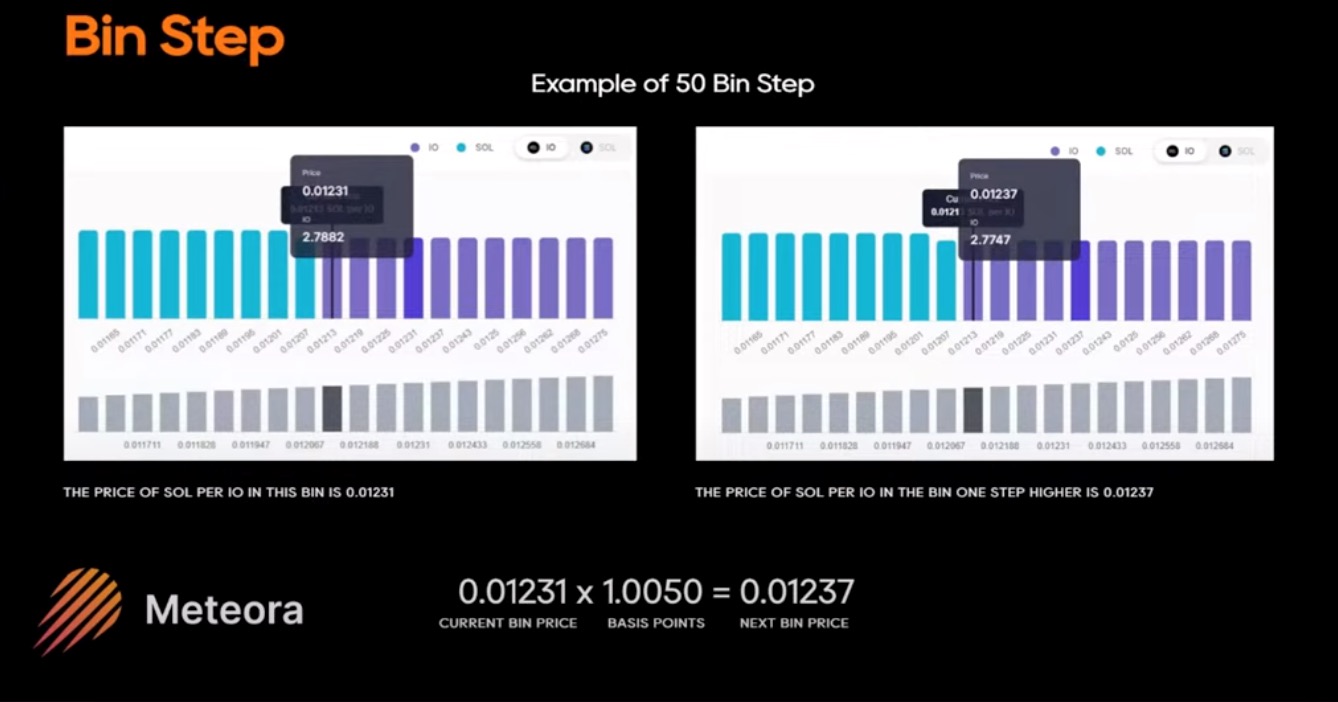
The higher the bin step, the greated the difference in price between two bins. A larger bin step can cover more price range than a smaller bin step. One would need more bins to cover the same price range with smaller bins
Available bin steps in a particular pool depends, in part on the base fee of the pool.
A lower bin step generates more fees bc it generates more fee event as the smaller the bing step the more bins would be needed, thus the more fees would be triggered per bin.
Strategies
3 main ones.
- Spot: Even distribution of all the tokens on all the avialable bins. Similar to doiing CLMM within a price range
- Curve: Concentrating most of the liquidity on a very specific price range. Maximizing what the capital might do. End of ranges do not perform as well bc they have less liquidity concentrated there
- Bid-Ask: Inverse curve, kinda DCA the token, liquidity concentrates at the end of the price range and gets less liquidity as it converges to the middle of the range
- Stacking Strategies *
- Spot + curve: Maximizing on middle point but earnign a bit more on the ends of the price range
- Spot + bid-ask: Maximizing on ends
Pool vs Position
Poll is two tokens with bin step and base fee that contains liquidity deposited by one or more wallets. these pools cannot be destroyed. Position is liquidity deposited into a pool. Only exists when depositiing and is destroyed when position is closed. There can be multiple possitions in a pool. There are a maximum of 1.4k bins per position
Returns on DLMM
-
Divergence Loss: It is very unlikely that we get the same liquidity out from the one we put in in the pool. this is divergence loss as the price of the provided token can diverge. The goal is to overcome this divergence loss with fees (that you take from the bins)
-
Positive return from fees: Fees earned through a DLMM position. Keypoints here should be Volume, Liquidity of the pool (TVL) and volatility. We can have the best price out there that if we don't have the liquidity, we are not gonna get the trade. A pool with a higher TVL would attract more swaps. is this tvl on the bin or the whole pool (i am guessing the whole pool)
-
Positive Divergence loss: Withdrawing at a higher value than the deposit value (i.e the supplied token price goes up) and you get also the fees